
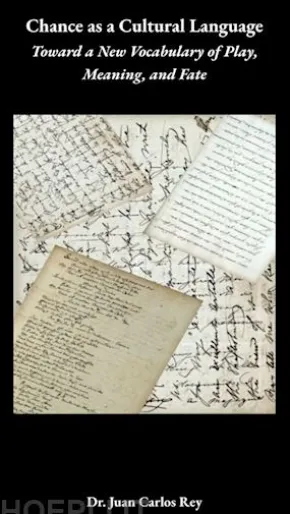
Chance As a Cultural Language: Toward a New Vocabulary of Play, Meaning, and Fate
€8.49
Compatibilità
- Computer
- Android
- Ebook Reader
- iPhone/iPad”
- Kindle
Dettagli
Genere:E-book EPUB
Lingua: Inglese
Editore:
Crow’s Cupboard Press
Pubblicazione: 02/2026
Trama
Chance as a Cultural Language: Toward a New Vocabulary of Play, Meaning, and Fateintroduces a rigorous and unsettling proposition: that chance has always spoken fluently, and that modern culture has simply forgotten how to listen.
Rejecting the authority-driven models that dominate contemporary divination, symbolism, and game studies, this book presentsGeroas a new analytic vocabulary for understanding how meaning arises through structured chance, shared attention, image, voice, and repetition. Gero does not function as a belief system, a method, or a predictive tool. It names a cultural condition in which fate is encountered without obedience, interpretation occurs without hierarchy, and meaning circulates without ownership.
Drawing on cultural history, performance theory, visual studies, anthropology, and the study of play, the book examines how societies have long used games, lots, images, and communal ritual to negotiate uncertainty. From lotteries and vernacular games to informal divination practices and popular sacred forms,Chance as a Cultural Languagedemonstrates that symbolic intelligence often survives most clearly where it is least institutionalized.
Central to the work is a sustained critique of interpretive authority. Tarot orthodoxy, occult professionalism, and rigid symbolic systems are examined not to be dismissed, but to be contrasted with practices that refuse codification and mastery. In their place, the book offers a disciplined account of how meaning can emerge through play without collapsing into superstition or control.
This is not a manual, not a system, nor a defense of randomness.
It is a serious, erudite exploration of how humans make sense together when certainty is unavailable and belief is optional.
For scholars of religion, anthropology, game studies, and cultural theory, the book provides a precise language for analyzing non-doctrinal symbolic systems. For occult practitioners, it offers a direct challenge to inherited assumptions about authority and interpretation. For general readers, it reframes play, chance, and fate as culturally literate practices rather than distractions or mysteries.
Chance as a Cultural Languageargues that fate does not need interpreters, only conditions under which it can be noticed.
Gero names those conditions.
And once named, they become impossible to ignore.
Rejecting the authority-driven models that dominate contemporary divination, symbolism, and game studies, this book presentsGeroas a new analytic vocabulary for understanding how meaning arises through structured chance, shared attention, image, voice, and repetition. Gero does not function as a belief system, a method, or a predictive tool. It names a cultural condition in which fate is encountered without obedience, interpretation occurs without hierarchy, and meaning circulates without ownership.
Drawing on cultural history, performance theory, visual studies, anthropology, and the study of play, the book examines how societies have long used games, lots, images, and communal ritual to negotiate uncertainty. From lotteries and vernacular games to informal divination practices and popular sacred forms,Chance as a Cultural Languagedemonstrates that symbolic intelligence often survives most clearly where it is least institutionalized.
Central to the work is a sustained critique of interpretive authority. Tarot orthodoxy, occult professionalism, and rigid symbolic systems are examined not to be dismissed, but to be contrasted with practices that refuse codification and mastery. In their place, the book offers a disciplined account of how meaning can emerge through play without collapsing into superstition or control.
This is not a manual, not a system, nor a defense of randomness.
It is a serious, erudite exploration of how humans make sense together when certainty is unavailable and belief is optional.
For scholars of religion, anthropology, game studies, and cultural theory, the book provides a precise language for analyzing non-doctrinal symbolic systems. For occult practitioners, it offers a direct challenge to inherited assumptions about authority and interpretation. For general readers, it reframes play, chance, and fate as culturally literate practices rather than distractions or mysteries.
Chance as a Cultural Languageargues that fate does not need interpreters, only conditions under which it can be noticed.
Gero names those conditions.
And once named, they become impossible to ignore.
Be the first to review “Chance As a Cultural Language: Toward a New Vocabulary of Play, Meaning, and Fate”
Related products
Sale!

Ebook
The Role of Network Security and 5G Communication in Smart Cities and Industrial Transformation
Original price was: €56.10.€38.16Current price is: €38.16.
Sale!

Ebook
Original price was: €15.30.€11.89Current price is: €11.89.

Sale!

Biografie
Original price was: €11.90.€9.26Current price is: €9.26.
Sale!
Dizionari E Grammatiche
4 – Animales II – Flash Cards Imágenes y Palabras Inglés Español
Original price was: €4.25.€3.39Current price is: €3.39.
Sale!

Ebook
Original price was: €3.40.€3.39Current price is: €3.39.

Sale!

Ebook
Original price was: €6.80.€5.01Current price is: €5.01.

Arte
€13.59

€2.46

€16.14
€13.59
Sale!
Original price was: €39.10.€28.81Current price is: €28.81.

Ebook
€5.01
Biografie
€1.69
Sale!

Ebook
Original price was: €3.40.€2.54Current price is: €2.54.

Reviews
There are no reviews yet.